
Butterflies Found in the Central Valley
Cabbage White
White butterflies make up 1.47% of the butterfly population. In North America the most populous butterfly is the Cabbage White (Pieris Rapae). These butterflies do not lay clusters of eggs instead they legs them individually on the surface area of garden plants. These include broccoli, cabbage, and cauliflower which serve as a perfect feasting area for freshly hatched caterpillars.
When emerged from the cacoon, the cabbageworms begin to feed. Female cabbageworms that intake more protein tend to develop a deeper pigmentation on the ventral (under) hindwing. Found in all cabbage white butterflies in a dark ventral hindwing which helps those born in colder climates maximize sun absorption.
When sunlight reflects onto their wings, ultraviolet (UV) light colors and shines off of them. Although undetectable to the human eye, other butterflies can detect it and is used for mate recognition and communication. A great nutrition along with proper development in the caterpillar stage enhances the UV coloration of the wings.
The cabbage white was introduced through the European importation of cabbages in the late 1800's. Today, the caterpillar form of the cabbage white butterfly is known as the "imported cabbageworm".


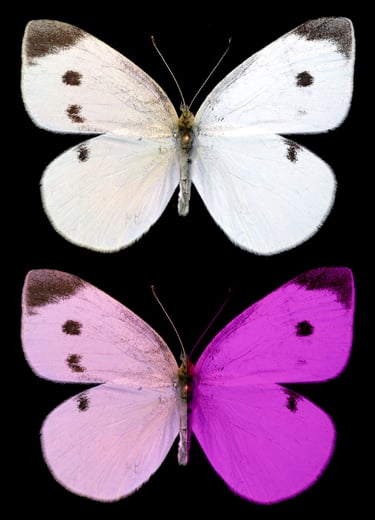
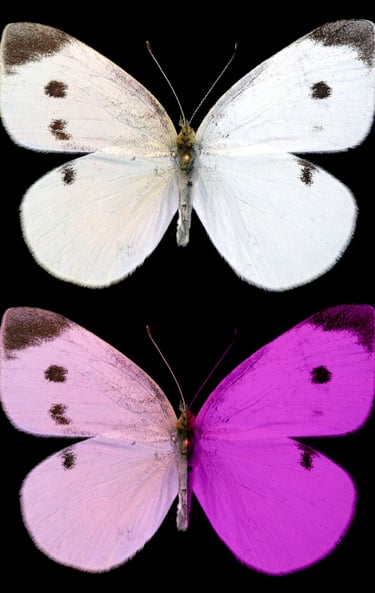
Image: (Schefft, 2017)
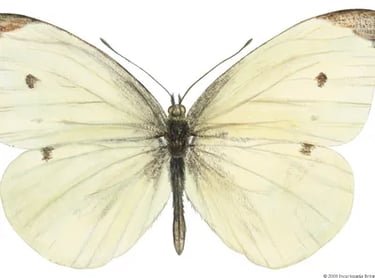
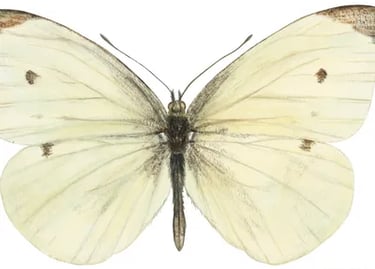
Image: (Britannica Editors, n.d.)
Identification:
Wingspan: 1.6-2.4 inches (4-6cm) Body Length: 0.8-1.2 inches (2-3cm)
The cabbage white butterfly has creamy white wings, with black tipped forewings. The males can be identified by one black spot on the forewing, while females have two. Their bodies are narrow and dark-colored.
With erratic flying patterns, these butterflies can be spotted near gardens (with plenty of vegetables) and open fields.
Red Admiral
The red admiral is known to be one of the widespread and frequently seen butterflies around the world, especially in North America, Asia and Europe.
Compared to other butterflies, Red Admiral are unusually territorial. They can even reach up to speeds of 30mph which is useful for males to protect their territory, typically a sunny patch of land.
The coloring of this butterfly is unique keeping in mind the speed in which they can fly up to. The red band across the forewings and coloration in the hindwings serves as a signal to predators. The Red Admiral's bold pigmentation serves to notify others that it is alert (thanks to their excellent vision) and FAST!
Unlike many other types of butterflies, Red Admirals are drawn to rotting fruit! When flower nectar is not available, these butterflies take favor in tree sap and overripe or rotting fruits and berries.


The ventral wigs of the Red Admiral appear leaf-life giving them a perfect camouflage to pair with bold, red wings!
Identification:
Wingspan: 2.0–2.9 inches (5–7.5 cm)
Body Length: 0.9–1.2 inches (2.2–3 cm)
The Red Admiral is easily recognized by its brown to black body with a vibrant reddish-orange band across the forewings and hindwings. It also has white spots near the tops of the forewings. The underside brown and gray similar to tree bark.
Red admirals are strong, fast fliers that can be spotted in open areas like gardens, parks, forest edges, and open ranges. They can often be spotted in searching for water in muddy puddles and wet soil.
Western Tiger Swallowtail
A fun characteristic tied to Western Tiger Swallowtails (Papilio Rutulus)is that they tend to fly in a "loop" pattern referred to as patrolling. This is common behavior when males are searching for a mate and checking on their territory.
Another interesting fact is the the decorative tails are not just for show - they can serve as a distraction to predators, and if ripped off, the butterfly is still able to fly. Speaking of wings, these butterflies are relatively larger among other butterflies in California. Due to their large wingspan and being ectothermic, they must be early risers. The morning sun heats up the Western Tiger Swallowtails wings, allowing them to generate body heat and take fight!
While much more common in the Eastern Yellow Swallowtail Butterfly, the female form can often have a genetic variation causing them to have a much darker appearance.


Identification:
Wingspan: 2.5-4 inches (6-10cm) Body Length: 1-1.5 inches (2.5-3.8 cm)
This butterfly has large, pale yellow wings with a black border around the edges and tiger-like stripes on the forewings. Near the tails are scales of blue and small orange spots. The ventral (under) side is a paler shade of yellow that can appear brown or gray in some-lighting to act as camouflage among leaves.
Can be spotted among rivers, cotton wood trees, suburban areas, and sunny, open areas.
The Papilio Rutulus caterpillar's defense is a camouflage themselves as bird droppings!
More to come...
References:
Britannica Editors. (n.d.). Cabbage white. In Encyclopaedia Britannica. Retrieved June 23, 2026, from Encyclopaedia Britannica - Cabbage White
Schefft, M. (2017, June 23). The birds and bees of butterflies [Photograph]. University of Cincinnati Magazine. https://magazine.uc.edu/editors_picks/recent_features/butterflies.html
Mission
To reconnect with nature, and—with curiosity and love—live closer to a more sustainable and connected world.
Connect
© 2025. All rights reserved.